
What Veterinarians Recommend for Cat Litter Boxes
What Veterinarians Recommend for Cat Litter Boxes
The AAFP and AAHA publish specific standards for litter box size, hygiene, and design. Most litter boxes on the market don't meet them. Here's what the guidelines say and why it matters for your cat.
If you've ever searched "vet recommended litter box" you've probably noticed that almost every product on the market uses that phrase. It's become meaningless through overuse. So let's do something different: look at what veterinary organizations actually publish about litter box design, cite the specific guidelines, and explain what they mean in practice.
The two leading feline veterinary associations in the United States are the American Association of Feline Practitioners (AAFP) and the American Animal Hospital Association (AAHA). Together they publish the Feline Life Stage Guidelines, a peer-reviewed clinical document updated most recently in 2021 that covers every aspect of cat health across life stages. Litter boxes get specific, detailed attention.
Here is what they say.
The 1.5x Size Rule
The most specific and most commonly violated guideline is about size. The AAFP and AAHA are direct: a litter box should be at least 1.5 times the length of the cat from nose to base of tail. The guidelines go further, noting that most manufactured litter boxes do not meet this standard and suggesting that owners use larger storage containers to achieve proper sizing.
To put that in practical terms:
For an average adult cat measuring 10 inches from nose to tail base, the minimum interior length is 15 inches. For a larger cat at 14 inches, the minimum is 21 inches. For a Maine Coon or Ragdoll at 16 inches, you are looking at 24 inches of usable interior space.
Walk into any pet store and look at the litter boxes on the shelf. Very few meet the standard for an average cat, and almost none meet it for a large breed.
The reason this matters is behavioral. Cats need room to turn, dig, and position themselves naturally before eliminating. When a box is too small, cats compensate by hanging over the edge, eliminating near the walls, or avoiding the box altogether. Litter box avoidance is one of the most frequently cited reasons cats are surrendered to shelters in the United States. In most cases it traces back to environmental factors the owner was never told about, including box size.
Why Corners Are a Hygiene Problem
The guidelines do not specify a round shape by name, but the hygiene principles they outline point directly to it.
The AAFP recommends that litter boxes be scooped daily and washed regularly with hot water. They specifically note that strong soaps and chemicals should be avoided because residue can deter cats from using the box. The underlying principle is thorough, complete sanitation with every cleaning.
Rectangular boxes make this nearly impossible. Corners collect waste that a scoop cannot fully reach. Bacteria and ammonia build up in those corners over time regardless of how often the box is cleaned. In a non-porous material like stainless steel, this matters less because nothing penetrates the surface. In plastic, which develops microscopic scratches within weeks, corner buildup becomes permanent.
A round interior has no corners. Every surface is accessible. One motion with a cloth covers the entire floor. The hygiene standard the AAFP is pointing toward is achievable in a round box in a way it simply is not in a rectangular one.
The Material Problem with Plastic
The AAFP guidelines do not name a specific material, but they describe a set of hygiene requirements that plastic cannot consistently meet. Daily scooping, regular washing, thorough sanitation, and a surface that does not retain odor between cleanings.
Plastic starts as a relatively smooth surface, but within weeks of regular use it develops microscopic scratches from scooping. Those scratches trap urine, ammonia, and bacterial waste permanently. No cleaning product fully reaches bacteria harbored in scratched plastic. This is why a plastic litter box that is cleaned every day still develops a persistent smell that gets worse over time.
Stainless steel at food and medical grade (304-grade) is non-porous. It does not scratch the way plastic does. It does not absorb urine. Bacteria cannot penetrate the surface between cleanings. When you wash a stainless steel litter box, you are actually cleaning it in the complete sense the guidelines intend. With plastic, you are managing a surface that is already permanently compromised.
304-grade stainless steel is the same material standard used in veterinary surgical equipment, commercial food preparation surfaces, and pet water bowls that veterinarians recommend. It is one of the most inert, non-reactive materials available for daily use around cats.
Entry Height Across Life Stages
One guideline that is easy to overlook addresses entry height. The AAFP specifically notes that litter box edges should not be too high for kittens or senior cats to enter and exit easily.
This becomes relevant as cats age. A cat with arthritis, reduced hip mobility, or declining muscle mass may struggle with a box that requires significant step-over height. Many owners don't notice the connection between a high-sided box and a senior cat beginning to eliminate outside it. The AAFP guidelines flag entry height as a specific consideration at both the kitten and senior life stages.
For most healthy adult cats, moderate wall height is ideal -- high enough to contain spray and litter scatter, low enough for comfortable entry. For households with senior cats, this is worth reviewing with your veterinarian as part of their regular care.
Litter Box Avoidance: The Health Consequence
The AAFP guidelines connect litter box design directly to health outcomes in a way that goes beyond inconvenience. Cats with urinary tract issues, feline idiopathic cystitis (FIC), or kidney disease are often particularly sensitive to litter box conditions. A box that is too small, retains odor, or feels uncomfortable can lead to elimination avoidance, which creates a cycle of retained urine, increased risk of urinary tract infections, and compounding health issues.
The guidelines address this at multiple life stages, noting that litter box management should be part of the conversation at every veterinary visit. For cats with diagnosed urinary conditions, your veterinarian will often ask specifically about box size, cleanliness, location, and the number of boxes available.
The clinical picture is straightforward: the right litter box environment reduces stress, supports normal elimination behavior, and removes one of the most common environmental contributors to urinary health problems in cats.
The N+1 Rule
The AAFP guidelines also address multi-cat households. The recommendation is one litter box per cat plus one additional, a principle commonly called the N+1 rule. For two cats, that means three boxes. For three cats, four boxes.
The reason is territorial. Even cats that appear to get along may feel competitive about shared resources, and litter boxes are a primary one. Insufficient boxes in a multi-cat home lead to crowding, stress, and avoidance. The guidelines recommend placing boxes in separate locations rather than side by side, since adjacent boxes tend to be treated as a single shared resource.
What This Means in Practice
The AAFP and AAHA guidelines, taken together, describe a litter box that:
- Is large enough for the cat to fully turn, dig, and position naturally
- Has a surface that can be completely sanitized with each cleaning
- Is made from a material that does not absorb urine or harbor bacteria
- Has an entry height appropriate for the cat's life stage and mobility
- Is available in sufficient quantity for the number of cats in the household
- Is placed in a quiet, accessible location away from food and water
Most manufactured litter boxes meet one or two of these criteria. The combination of adequate size, non-porous material, corner-free interior, and appropriate entry height in a single product is genuinely rare.
How the Huckwell Halo Meets the Guidelines
The Halo Litter Box was designed with the AAFP standards as a baseline, not an afterthought.
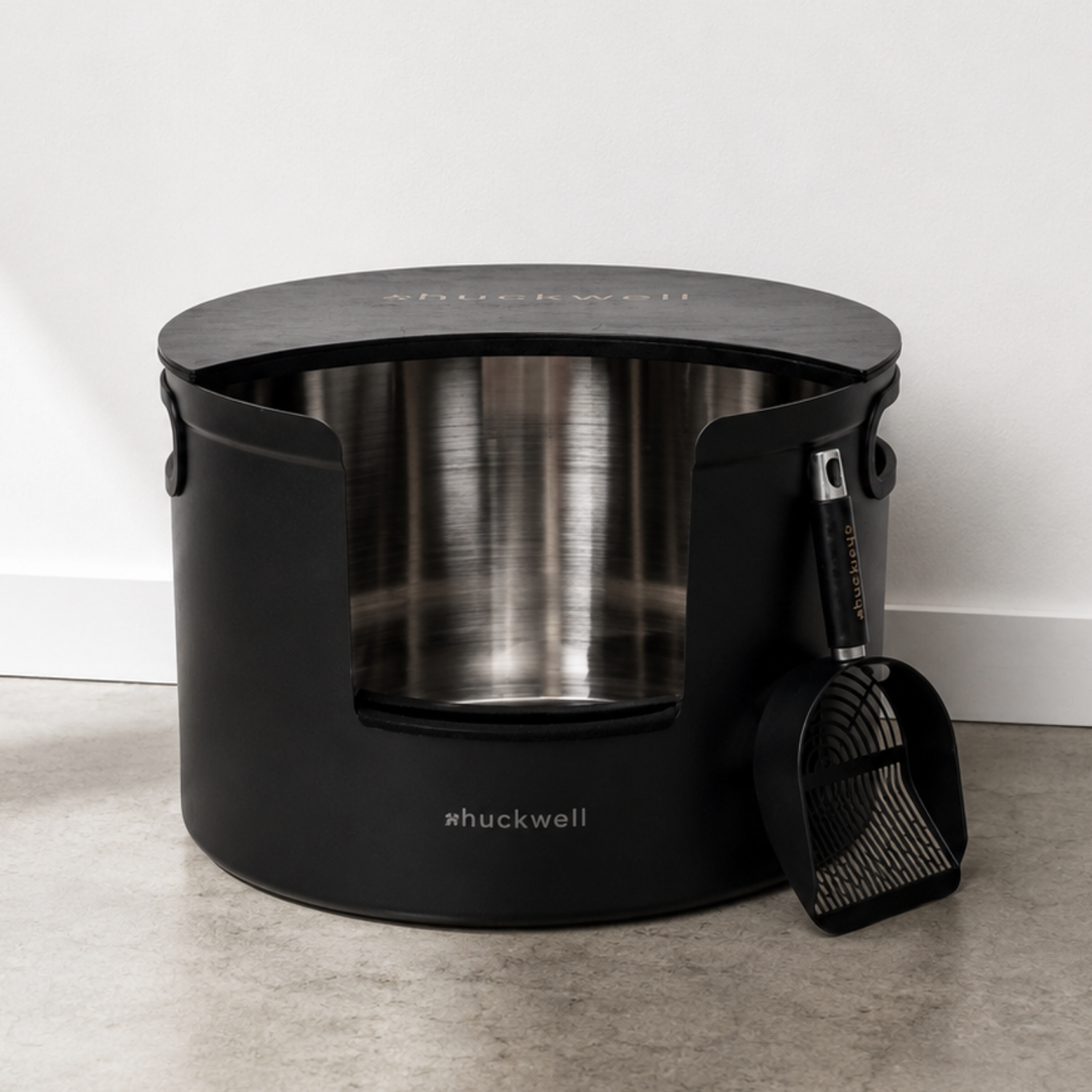
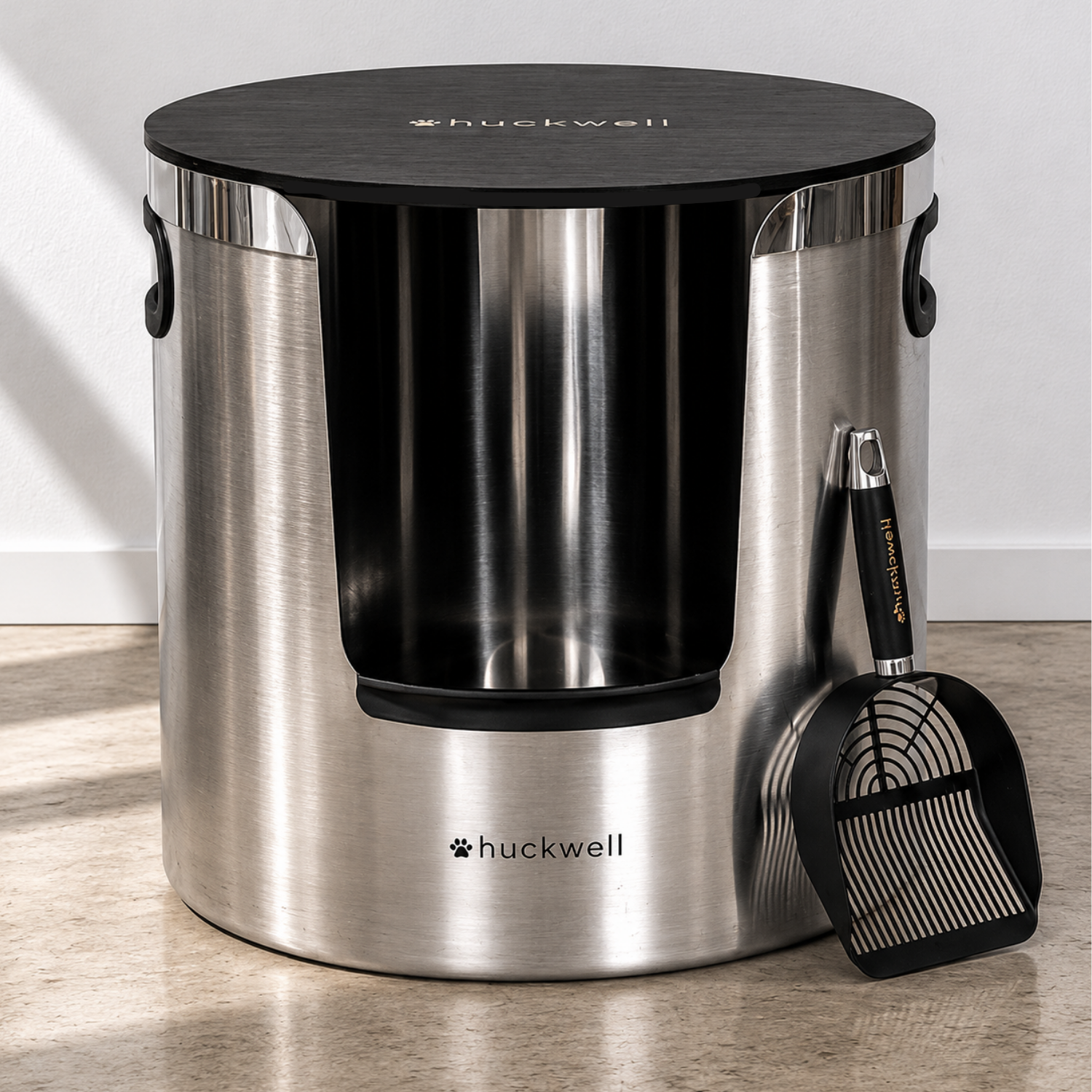
The Halo Classic provides 18 inches of interior diameter, meeting the 1.5x standard for most adult cats. The Halo XL provides 23.6 inches, meeting the standard for large breeds including Maine Coons, Ragdolls, Siberians, and Norwegian Forest Cats. Both are built from 304-grade stainless steel, which is non-porous, non-toxic, and does not degrade in the ammonia-heavy environment of a litter box. Both have a round interior with no corners, making complete sanitation possible with every cleaning.
The Halo Extra Tall maintains the Classic's 18-inch diameter with 16-inch walls for cats that spray or kick litter aggressively.
None of this is marketing language. It is a direct correspondence between published veterinary guidelines and design decisions. That is what vet-informed design means.
The Bottom Line
Most litter boxes are designed around manufacturing cost and retail shelf dimensions, not feline health. The result is a category full of products that are too small, made from materials that cannot be fully sanitized, and shaped in ways that work against natural cat behavior.
The AAFP and AAHA guidelines exist because veterinarians see the consequences of this in practice every day -- cats surrendered for "behavioral problems" that turn out to be litter box avoidance, urinary health issues connected to inadequate hygiene, and senior cats quietly suffering in boxes that hurt to use.
Getting the litter box right is not complicated. It requires size, material, shape, and cleanliness. The guidelines tell you exactly what each of those means. The Halo was built to meet all of them.
Sources:
- 2021 AAHA/AAFP Feline Life Stage Guidelines, General Litter Box Considerations: https://www.aaha.org/resources/2021-aaha-aafp-feline-life-stage-guidelines/general-litter-box-considerations/
- 2021 AAHA/AAFP Feline Life Stage Guidelines, Behavior and Environmental Needs: https://www.aaha.org/resources/2021-aaha-aafp-feline-life-stage-guidelines/behavior-and-environmental-needs-young-adult-cats/
- AAFP and ISFM Guidelines for Diagnosing and Solving House-Soiling Behavior in Cats: referenced in the 2021 guidelines